
Beyond the misunderstood world of networking lies a new reality. AI can draft a flawless CV in seconds, but humans still make the hire. At the same time, the traditional education model is under pressure. And lastly, the importance of attitude. A skill that no algorithm can ever replace.
We live in a world that has never been more connected, yet many feel further apart than ever. We chat endlessly about everything, but young people are scared to pick up the phone. To understand this paradox, I sat down with Emilia Konttinen, career coach at Vlerick Business School. Since the school is currently ranked second in the world for its career services, her experience in this field is incredible. She works with students every day, guiding them through ambition, uncertainty, and AI. Her message is simple: embrace the human factor because it is not disappearing, on the contrary.
To Network, or To Be Networked
When the word networking pops up, many people sigh. The term feels awkward, even manipulative. As a student, I sometimes wonder what I could possibly offer in return for a recruiter’s time. It is easy to assume that networking is about asking for favors, about needing something before you have anything to give.
The reality is far simpler. Networking, as Emilia explains, is often misunderstood. “It is not about taking something. It is about exchanging knowledge, advice, ideas, and experiences. Things that Google or AI cannot replicate in the same way.” A search engine might give you information. AI can produce a tidy overview in seconds. Yet a personal interaction reveals the human behind a career. Real insights. What surprised someone in their first job? What they wish they had known sooner? What does the day-to-day really look like?
Approach it (networking) like a conversation at a party. Ask questions and listen.
Yet one of the biggest misconceptions, she argues, is that networking should yield immediate results. It is a slow and often indirect process. A job in the company of the person you’re networking with can be the end goal, yet it should never be your mindset. The aim is to grow bottom-up. The real value lies in accumulation: insights gathered, perspectives broadened, relationships gradually strengthened. This applies not only to students, but to professionals at every stage. Instead of aiming straight for the CEO or a senior partner, Emilia advises speaking to people only a few steps ahead. They still remember what it is like to start and can offer the context you need.
Curiosity, she adds, is more powerful than conveying confidence. Networking works best when it feels natural rather than a forced conversation. “Approach it like a conversation at a party. Ask questions and listen.” And it does not end after the first conversation. Send them a short thank-you message afterwards. Keep them updated about your progress. “Everything you do in networking is a direct reflection of how they perceive you. And first impressions last.”
Handshakes over Hard Skills
I must admit, I once imagined university as a fairly linear path. Hard work earned me a degree. This degree will then open doors, signal competence, and eventually get me hired. Is this mindset naïve? The more I speak with people in the field, the clearer it becomes that hard skills are not the only thing. A CV may showcase what I can do, but it can never tell who I am.
This raises an uncomfortable question: Is landing the job of your dreams purely about knowing the right people? Does the network outperform the skills?
“You need both,” says Emilia. “Knowing all the right people will never be enough to get you a job. Yet, in the end, it is a person who gives you a job, not your CV.” Hard skills remain essential. Without competence, there is nothing to build on. Yet recruitment is ultimately human. Decisions are made by individuals, not algorithms.
In that sense, networking is not a shortcut around ability, but a complement to it. Connecting with people offers insights into how a company operates, thinks, and hires. It teaches you where opportunities might emerge. AI can make a perfect CV for you in a couple of minutes. So distinguish yourself by asking good questions, she suggests. “Ideally, people think spontaneously of you when trying to fill a vacancy. A personal connection will always be preferred over having to go to HR, creating a job description, and processing the applications.”
Rise above AI
Mass-applications. A new trend that, perhaps not by coincidence, ends up on my social media feed. With one click, an app sends out a polished CV and a convincing cover letter. Of course, all adapted to the company and job to which I am applying. Efficient. Almost irresistible.
However, when everyone uses the same tools, you blend in. Does anyone want to be generic?
In times of AI, writing I am very motivated in a cover letter means nothing anymore.
According to Emilia, the process should be reversed. “Start with the people who might give you the job, not the vacancy.” At the same time, embrace AI. Do not just shove it aside. “In today’s application landscape, you cannot have a spelling error on your CV.” At the same time, a recruiter can sense a fully AI-generated cover letter from miles away.
By the time a mass application is submitted, the competition may already have reached out and spoken to the person behind the vacancy. The race often begins long before the official job post appears. In that sense, networking still matters. “Writing I am very motivated in a cover letter means nothing anymore,” she adds. The winning combination is simple. Use AI for efficiency, and humans for connection and insight. Rise above those who don’t use AI. Then again, rise above those who only use it.
The Future Value of a Degree
The value of a traditional degree is being questioned more than ever. Several CEOs, mostly in tech, argue that the traditional higher education model might become irrelevant in times of AI. During an informal chat in San Francisco, LinkedIn CEO Ryan Roslansky mentioned: “The future of work belongs not to the people with the fanciest degrees, but those who are adaptable, forward-thinking, ready to learn, and ready to embrace these tools.” Others, including NVIDIA’s CEO Jensen Huang, have argued that business schools may become irrelevant unless they drastically evolve. How do you keep your head above the water?
For Emilia, the answer is pragmatic. In the end, education and business schools in particular prepare students for the labour market. These institutions want to know what the job market needs and will adapt themselves to it. AI literacy, especially for the youth, is going to be an incredibly valuably skill. You cannot believe blindly everything that GenAI is producing for you. Education should teach people how to learn, but also how to learn how to adapt. Because things are changing quickly.
It (networking) is not about taking something. It is about exchanging knowledge, advice, ideas, and experiences.
In her view, some institutions approach AI too superficially. “Universities and business schools should not add courses on AI,” she says. “They must teach people how to collaborate with it and integrate it into everything they do.” Degrees, she believes, are unlikely to disappear in the near future. Yet who knows what will happen in the long term?
Taking Ownership of Your Career
Imagine you still went to college (although some CEOs did not recommend it), you networked with success, and landed a job. Does it end here? When I asked Emilia what the biggest mistake ambitious young professionals make, her answer was immediate: waiting.
“People should not wait for things to fall into their lap. People should not get too comfortable that landing this one job will be enough to reach the top levels. Do not think that people around you are going to make this happen for you. It is you who is going to make things happen for you. A good mentor or manager might occasionally put you in the spotlight. But in that visibility, it is you who needs to be on top of your game.”
She is critical of people who believe they can simply fake it till they make it. That strategy rarely holds in the long run. “They will eventually be exposed.” In most professional environments, you are surrounded by people who genuinely live their ambition. They know what they want and signal it consistently: their body language, the way they listen, the way they ask questions, …
This leads to a broader question: how much of that drive and attitude can actually be taught? Can schools shape ambition and professional maturity, or are these qualities largely inherent?
It is you who is going to make things happen for you.
“To some degree, yes,” Emilia believes. In your twenties, a large amount of professional maturity still needs to be built. And that’s normal. Behavior can change as you mature. Professionally, your priorities might shift. “But there are also very inherent personalities, traits, or attitudes that often come from home. It originates from the way you were brought up, what you believe in. And that is very, very hard to change.”
Inspired by … Emilia
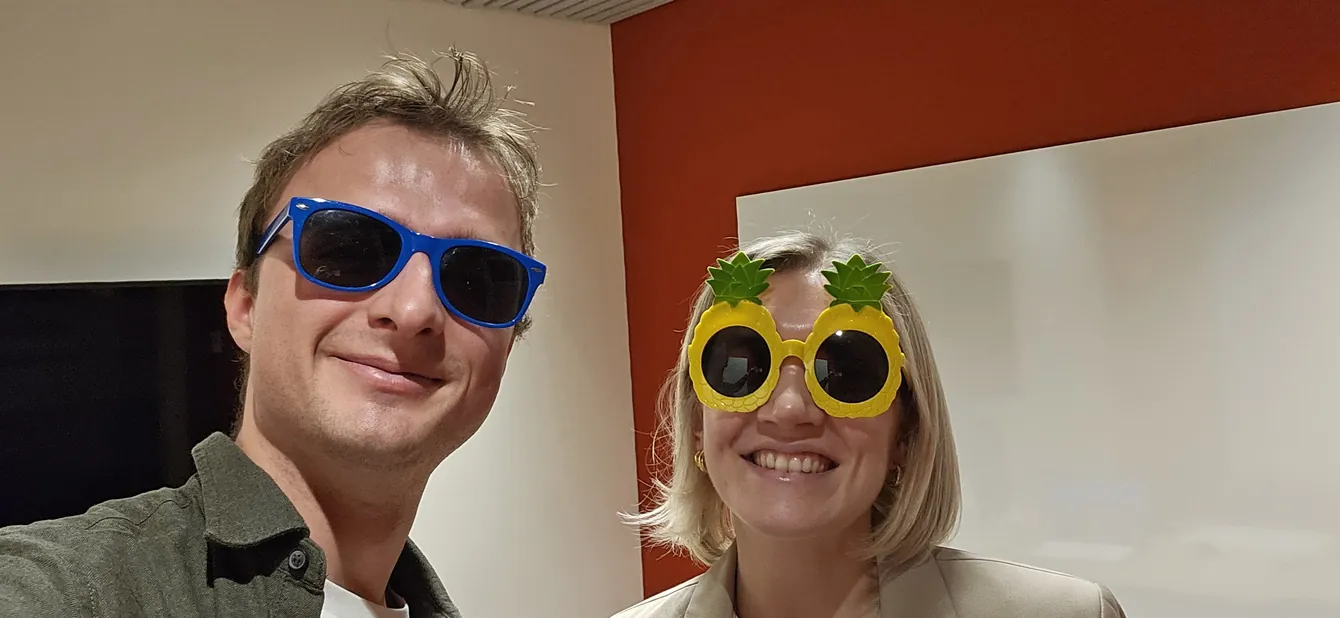
Emilia Konttinen was born and raised in Finland. She studied international business management in Belgium and later worked for three years as the personal assistant to a scale-up CEO in Italy. Eventually, she returned to the land of chocolate, fries, and beer to join Vlerick Business School. She speaks five and a half languages, plays the violin, and has always been drawn to music and dance.
Past - Advice to Your 20-Year-Old Self?
She initially laughs, “one of these million-dollar questions”. She had initially prepped multiple answers. However, I pressed her to pick one.
“Dare to think of life not so goddamn serious all the time,” she says. “In my twenties, I was extremely stressed about the future, a perfectionist, everything… But things will work out in the end. Linked to that, if you can - and I think everyone can to a certain extent - invest time and resources into building strong self-esteem and self-confidence. How? Surround yourself with good people. Visit a therapist. Get an older mentor. Whatever works for you.”
Present - What Inspires You Today
Right when introducing herself, Emilia immediately emphasized that life is about more than work. This showed on multiple occasions during the interview, in particular when asking her what inspires her today.
“Music and movement, and going beyond the usual. I played violin for many years. I sing and dance. Secondly, people and their stories. Listening to individuals and trying to understand why they did what they did. How they ended up where they are now. What they learned. Especially when the person in front of you is really inspiring and has had a rich life. It’s not about the biggest achievements, but about the everyday things.”
I find myself agreeing, especially with that last remark. You would not want to hear me sing. Yet those ordinary, unexpected conversations are precisely why I started this concept in the first place. They are often the moments that I remember most.
Future - Your Big Bet
Although she laughs at the idea of being a visionary, she does not hesitate when asked about the future.
“I’m always astonished by how much frustration and anxiety people have. I definitely hope this will disappear. But a big bet, I don’t think so. I do wish that there would be a shift in people in power and how they use their power, remaining vague on purpose.”
There is, however, one area where she is very clear. “Additionally, I hope girls and women all over the world will get the proper and true education. Not just in reading and writing, but also in how their bodies work and how they can make the most out of life. Research in the female body and mind is lagging massively behind. I hope this information gap will be reduced in the future. There is still so much work to be done on this topic, and I am glad to see that there are efforts being made.”
A note on transparency: ChatGPT (GPT-5.2) and Google Gemini (Gemini 2.0) were used for editorial review only. All research, ideas, and analysis are the author’s own. Views expressed are those of the interviewee